
Search info
What Are You Looking For?
From toll roads to campus parking, UHF RFID lets vehicles pass without stopping. This article explains how the FR54A-E reader leads the solution, with the barrier gate matched as an accessory.
SeeMore 星眸 · Highway ETC & Parking: How the FR54A-E Reader Leads (Barrier as Accessory)
What "pass without stopping" really means
SeeMore 星眸 · 方案示意图 — Highway ETC & Parking: How the FR54A-E Reader Leads (Barrier as Accessory)
The core of both ETC (electronic toll collection) and smart parking is the same: identify "who is this" accurately while the vehicle does not slow down. Plate recognition suffers from light, dirt and angle; UHF RFID gives each vehicle a reliable on-board tag (OBU or sticker) read steadily from meters away, unaffected by weather or grime.
The core: the FR54A-E reader
In this scenario we lead with the Symo FR54A-E fixed UHF reader:
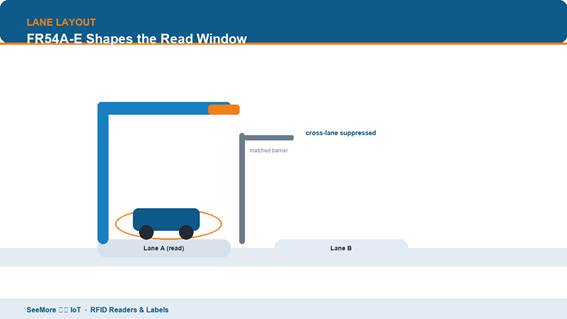
· Fixed form with antennas placed along the lane, shaping the read field into a "recognition window" that cuts cross-lane reads.
· Built-in edge compute (RV1106, 0.5 TOPS NPU) — ID and decisions happen on-device, with local fallback even offline.
· Impinj E710 chipset for stable RF; and −25~+70°C wide temperature for year-round outdoor gates.
· Native local RF type-approval (for LatAm-style requirements) plus a 2-year warranty.
The actuator: matched barrier hardware
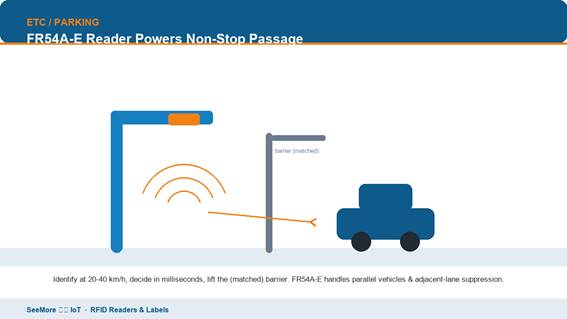
Once vehicle identity is confirmed, the "raise the bar" action needs to happen — usually handled by a high-speed servo barrier gate. The barrier is a matched execution accessory (e.g. the D3BG series: fast lift, long life, various booms and accessories), linked to the reader over a standard interface: on confirmed ID it sends the lift signal. SeeMore leads with the FR54A-E reader for the complete ETC identification solution and matches barrier hardware per project.
How a lane is read
At a typical toll plaza, each lane mounts a FR54A-E + antenna on a gantry or post, with the field aimed at that lane's "recognition window". When lanes run in parallel, the fixed form pays off: antennas hug the target lane so a neighbouring vehicle passing at the same time will not falsely trigger this lane's lift. At 20–40 km/h, ID and passage decision finish in milliseconds.
What edge compute actually saves
Many assume "identification" must ship data back to a center. With FR54A-E's built-in edge compute, the device judges "raise or not" locally even offline — three gains:
· No center dependency: lane keeps working during central maintenance or network jitter.
· No peak-hour stall: local decisions do not queue under holiday traffic spikes.
· Local record first: each passage is logged on-device, then sent async — disputable later.
Complementing plate recognition, not replacing it
RFID identifies the "vehicle" reliably; plate identifies the "plate" intuitively. Real projects often pair them: RFID as the main fast-pass ID, plate as the check and fallback for untagged vehicles routed to manual/plate lanes. This keeps throughput high without losing traceability.
Typical deployments
· Toll plaza: multiple parallel lanes, one FR54A-E + antenna per lane with a barrier aside; transaction and ID are separated — pass only on a good read.
· Campus / plant parking: entry ID raises the bar; whitelist or temporary auth splits staff and visitors.
· Logistics-park gate: see the industry piece below — bind vehicle to cargo, auto-check on entry/exit.
|
▶ Building a toll, parking or logistics-gate project? Tell SeeMore your lane count, speed, boom type and requirements. We lead with the FR54A-E reader and match D3BG-class barrier hardware, with units to test. |

Tel : +8618682338756
Email : info@seemoretek.com
Whatsapp : +8618682338756


© 2026 SeeMore IoT Technlogy Co.,Ltd. All Rights Reserved.