From a Single Yarn to a Finished Garment -- How UHF RFID Readers Connect the Entire Textile & Apparel Production Chain
A pair of jeans passes through eight operations and changes hands more than thirty times before it leaves the line. A batch of greige fabric endures 130°C inside a dyeing vat before it can be unloaded. Yet many plant managers still cannot answer two basic questions: how much work-in-progress is on the floor right now, and where exactly has that roll of fabric got stuck?
Barcode-era workflows rely on manual scanning — missed scans, retroactive entries, and lagging paperwork are routine. HF/NFC requires near-contact reading. As soon as line takt time drops into single-digit seconds, data capture becomes the slowest link in the entire chain.
The value of UHF RFID is simple: it stretches "readable distance" from 5 cm to 5 m, and turns "one item per scan" into "hundreds of items per second."

1. Why UHF — Not Barcodes or HF?
UHF RFID operates in the 840–845 MHz / 920–925 MHz bands (China allocation) and follows the ISO/IEC 18000-63 (EPC Gen2 / C1G2) air interface protocol. It is not a cosmetic replacement for barcodes — it is a fundamentally different data channel, purpose-built for bulk, contactless, and dynamic capture.
| Dimension |
1D / 2D Barcode |
HF / NFC |
UHF RFID |
| Read range |
Must be aimed, < 0.5 m |
Near-contact, < 0.1 m |
0.5–10 m, adjustable per scenario |
| Line of sight required |
Yes, sensitive to soiling |
Yes, must be close |
No — reads through cartons, film, bundled rolls |
| Bulk reading |
One at a time |
One at a time |
Dozens to hundreds at once, typically 500+ tags/sec |
| Reading in motion |
Practically impossible |
Practically impossible |
Supports high-speed dynamic reads |
| Tag cost |
Very low |
Medium |
Woven-label UHF tags now in the CNY 0.3–0.8 range |
| Rewritable |
No |
Partially |
Yes — can carry changing work-order data per operation |
| Fit for fabric & garments |
Smudges, falls off |
Needs encapsulation |
Available as hangtags, care labels, cable ties, high-temp dye tags |
In one sentence: barcodes suit item-by-item registration; UHF RFID suits real-time awareness of whole batches in motion.
2. Ten Deployment Points Across the Production Chain
1. Raw Material & Yarn Receiving — An ID for Every Cone
- Pain point: trucks queue at the dock, and goods receipts take three days to reach the system.
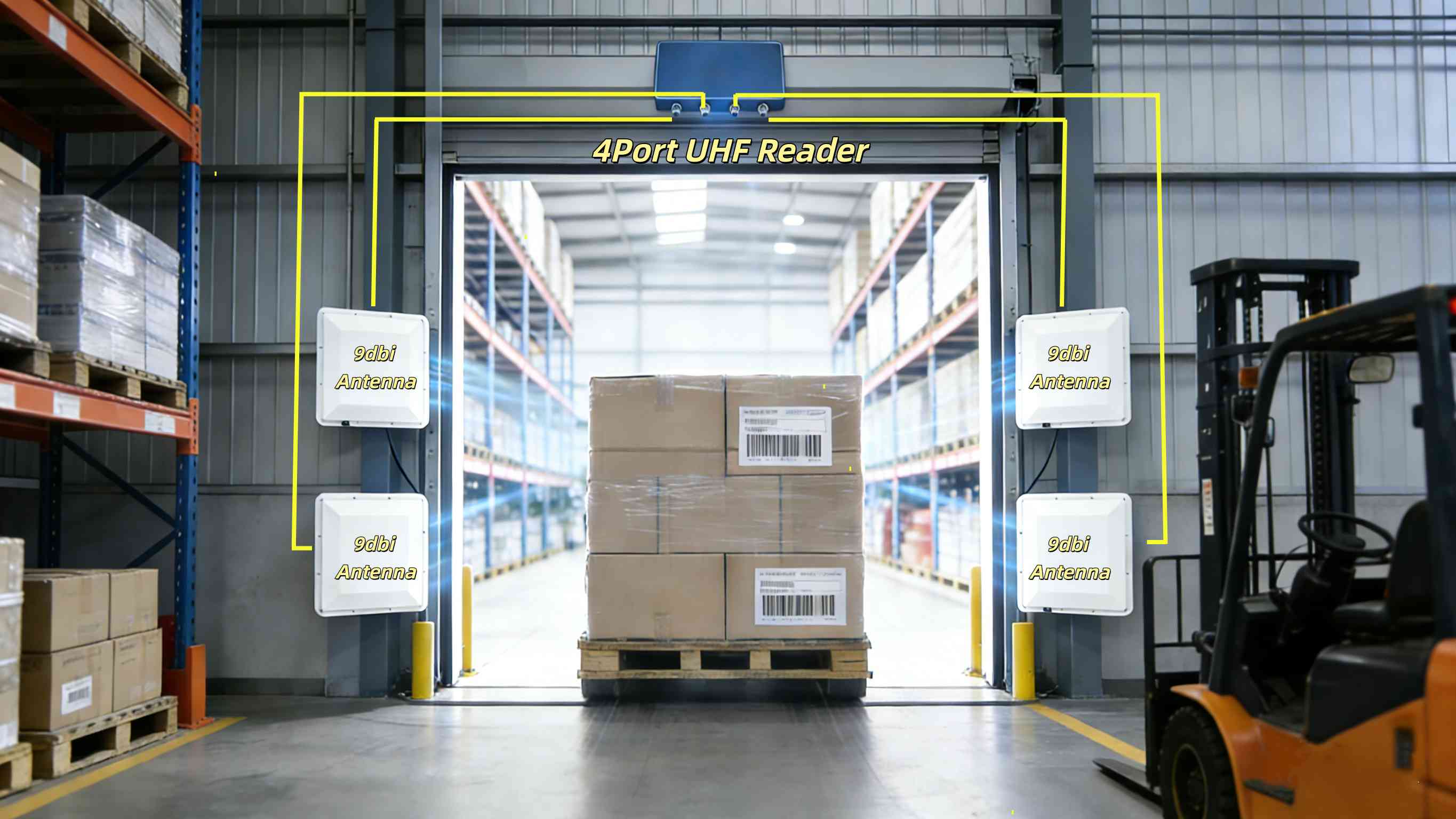
- RFID approach: suppliers pre-tag, or staff bind EPCs at pallet, carton, and cone level on arrival. Deploy RFID portal gates at unloading bays so forklifts trigger automatic batch receipt creation simply by passing through.
- Hardware: 4-port / 8-port fixed reader driving four antennas to form a dual-sided gateway frame.
- Result: unloading and system entry happen simultaneously — receiving labor reduced by over 60% (industry indicative figure).
2. Weaving Floor — Managing Beams, Looms, and Fabric Rolls
- Pain point: machine efficiency, remaining warp length, and roll location all depend on manual reporting.
- RFID approach: mount on-metal hard tags on warp beam ends (impact- and oil-resistant); after doffing, attach or sew flexible roll tags to both ends of each fabric roll, bound to roll number, style, loom ID, and doffing time.
- Hardware: integrated reader-antenna units on floor columns; vehicle-mounted readers on transport carts.
- Result: loom data flows back automatically — roll search time drops from ~20 minutes to under 1 minute.
3. Dyeing — The Hardest Stage, and the Most Valuable
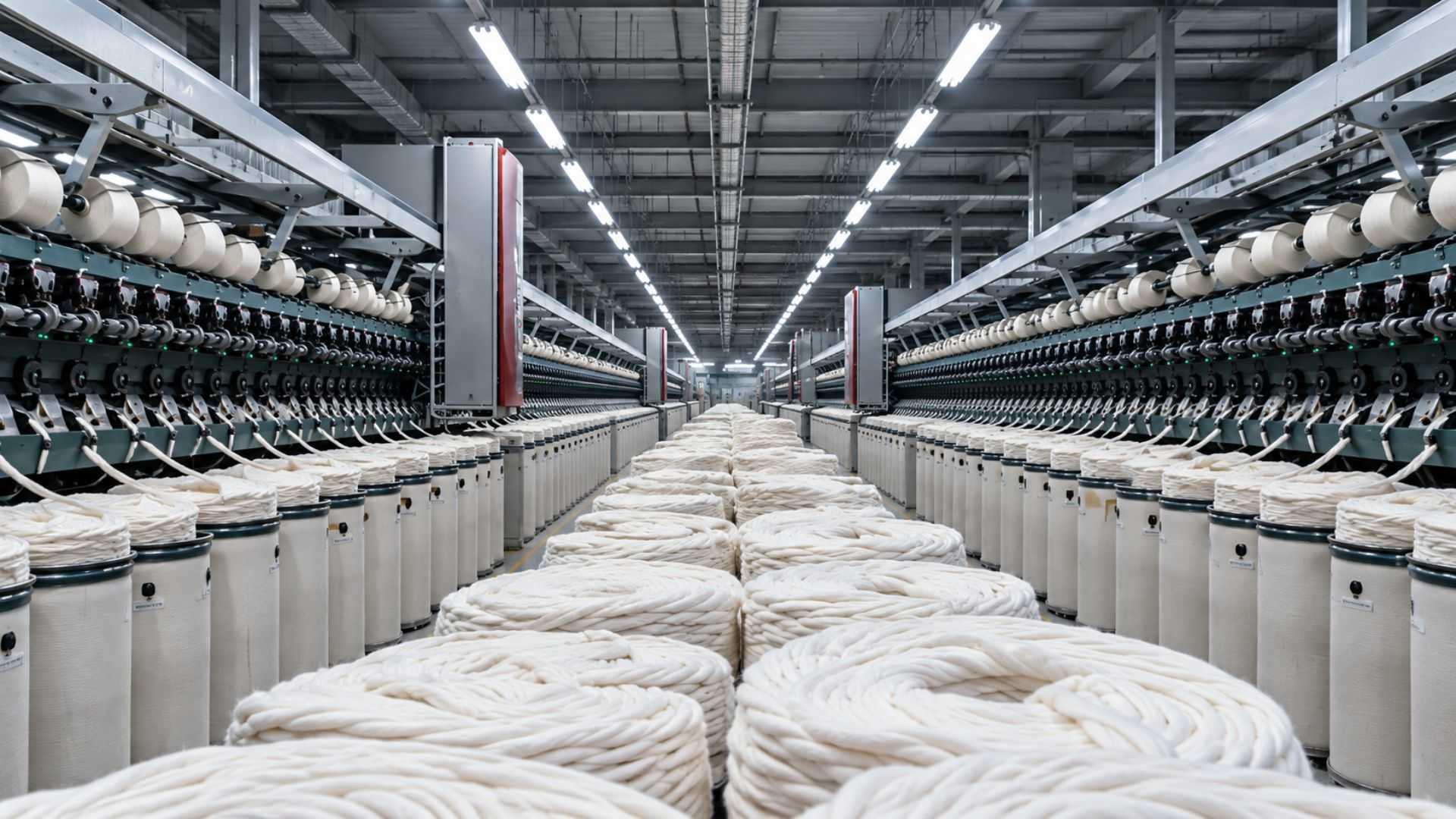
This is the technical high ground for UHF RFID in textiles: extreme heat, humidity, aggressive chemicals, and metal vats all around. But precisely because the process is irreversible, traceability delivers the highest quality-control value here.
- RFID approach: use dye-vessel-specific tags rated to 200°C, acid/alkali resistant and washable, sewn onto the fabric head to travel through the batch; readers at vessel entry/exit and stenter entry/exit automatically log vat numbers and process-curve milestones.
- Key engineering considerations:
- Keep antennas away from high-power VFDs and motor interference sources;
- Use circularly polarized antennas to handle random roll orientation;
- Apply frequency planning and time-division scheduling in dense reader zones to avoid mutual interference.
- Result: vat ID and roll are bound automatically, eliminating batch-mixing ("vat cross-contamination") incidents; every roll carries a complete process record for one-click evidence in customer claims.
4. Finishing & Fabric Inspection — Defect Data Without Re-Keying
- RFID approach: install a desktop reader / embedded RFID module at inspection stations to automatically associate the current roll ID with defect entries; grading results are written straight back into the tag user memory.
- Result: quality data lands in the system in real time, and A-grade / B-grade decisions directly drive subsequent marker planning.
5. Cutting Room — Electronic Bundle Tickets Replace Paper Tickets
- Pain point: traditional paper bundling tickets get lost, soiled, and mixed up, and their location cannot be sensed automatically.
- RFID approach: switch to RFID cable-tie tickets or chip-embedded bundle tickets; deploy read antennas at spreading, cutting-table, sorting, and bundling stations.
- Result: bundling error-proofing — the system instantly flags "these cut panels were sorted into the wrong size"; cutting-area progress becomes visible, with automatic alerts for missed or duplicated panels.
6. Sewing Floor — Automatic Operator Reporting on Conveyor Lines (Fastest ROI)
- Pain point: operators manually scan a paper ticket for every piece — thousands of repetitive motions per shift.
- RFID approach: tags embedded in overhead conveyor hangers; reader-antenna units installed at every workstation on every line. The instant a hanger docks at a station, the read is complete and labor is auto-charged.
- Result:
- Manual scanning at the workstation is eliminated — 8–15 seconds saved per piece;
- Operation takt, WIP accumulation, and bottleneck stations become visible live, raising line balance rate;
- Subcontracted/outsourced pieces stay under control throughout their flow.
7. End-of-Line: Pressing, Hangtag, Packing — The Final Check Before Shipment
- RFID approach: portal-based reads after finishing automatically verify "complete style, color, and size set"; when garment hangtags are replaced, EPC and retail barcode are re-bound.
- Result: style, color, and size mix-ups are intercepted before carton sealing — not discovered by the customer on opening.
8. Finished Goods Warehouse — Second-Level Inbound, Outbound, and Counting
- RFID approach: RFID portals with photo-eye triggering at warehouse doors and shipping docks; full cartons are captured in bulk as they pass; bin-level counting uses industrial handheld readers.
- Result: where a full-warehouse count once required a full production stoppage day, counting now runs in parallel with operations at 10–30× the efficiency, inventory accuracy rises from roughly 85% to above 99%, and mis-shipment costs fall sharply.
9. Logistics & Retail — One Tag All the Way to the Store
- RFID approach: the same tag continues into finished-goods distribution, store receiving, fitting-room data capture, and EAS anti-theft integration.
- Result: store counts shrink from "two hours with the shop closed" to "ten minutes any time"; omnichannel inventory visibility enables ship-from-nearest-store and reduces stockout losses.
10. Traceability & Recall — The Long-Term Payoff of Accumulated Data
Once fabric batch, vat number, operation, machine, and operator are all recorded, any quality issue can be scoped to the affected batch within minutes — instead of a blanket recall or full-line rework.
3. Choosing Hardware: One Reader Cannot Solve Every Problem
Most failed projects do not fail on technology; they fail because a general-purpose reader was dropped into a production environment. For textile and apparel scenarios, focus on these six points:
- Dense-reader-mode algorithm: dozens of tags packed into one bundle of garments test the anti-collision algorithm and receive sensitivity — nominal read range alone tells you nothing.
- Environmental durability: heat and humidity in dyeing, dust and lint in cutting, steam at end-of-line. Enclosure should be IP65 minimum, and connectors should resist oil contamination.
- Installation friendliness: conveyor-line workstations are cramped — prefer integrated reader-antenna units; for workshops with many geographically spread capture points, choose PoE-powered multi-port fixed readers.
- Interference-resistant design: VFDs, servo motors, and metal rollers are the dominant interference sources; pair proper antenna polarization selection with tuned mounting angles.
- Interfaces and SDK: support for the LLRP standard protocol, Windows / Linux / Android SDKs, and MQTT, HTTP, WebSocket read-event push, for clean integration with ERP, MES, and WMS.
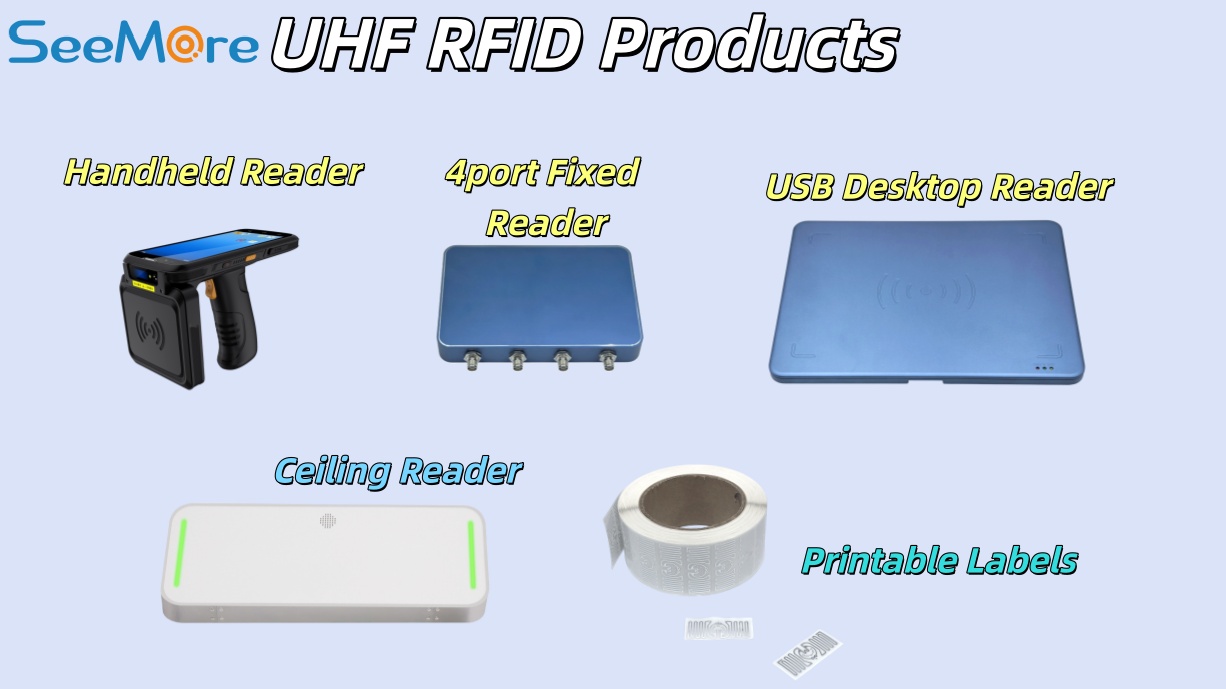
- Complete form factors, one vendor: fixed readers, integrated units, desktop readers, industrial handhelds, portal readers, embedded modules — sourced from a single supplier to avoid multi-brand protocol friction.
Selection Quick Reference by Station
| Application point |
Recommended form factor |
Core value |
| Warehouse / shipping dock doors |
RFID portal reader |
Second-level bulk verification of full cartons and pallets |
| Sewing conveyor workstations |
Integrated reader-antenna unit |
Hands-free automatic operator reporting |
| Beside looms and inspection machines |
Multi-port fixed reader (PoE) |
One unit covers 4–8 capture points |
| Receiving encoding / re-binding station |
Desktop reader-writer |
Fast encoding, rebinding, verification |
| Cycle counting and roll location |
Industrial handheld reader |
Long-range bulk reads, offline capable |
| Built into own equipment |
Embedded RFID module |
OEM integration into inspection machines and conveyor bodies |
4. What Returns Can You Expect?
The ranges below are commonly observed in comparable deployments. Actual results depend on your automation maturity, management foundation, and rollout scope — we normally provide plant-specific projections after a free assessment:
| Metric |
Typical before |
Typical after |
| WIP visibility |
Daily reports, > 1 day lag |
Live, latency < 10 seconds |
| Finished goods count efficiency |
Full line stoppage, 1 day |
Counts run alongside operations, 10–30× faster |
| Inventory accuracy |
80%–90% |
≥ 99% |
| Fabric / item search time |
~20 minutes average |
< 1 minute |
| Production reporting time per piece |
8–15 seconds manual scan |
0 seconds (automatic capture) |
| Mis-shipment rate |
0.3% – 1% |
Reduced to sub-0.01% levels |
| Store count duration |
2 hours closed |
Under 10 minutes, any time |
For most apparel manufacturers producing around 2 million pieces annually, payback typically falls within 8–18 months.
5. Deployment Method: Close One Small Loop First, Then Scale
We do not recommend tagging the entire plant on day one. The standard cadence is:
- Step 1 · Pilot the most painful stage (usually sewing reporting or finished-goods counting) — visible results in 2–4 weeks;
- Step 2 · Connect a single data flow: conveyor line → end-of-line → finished goods warehouse, verifying end-to-end data continuity;
- Step 3 · Extend upstream: cover dyeing, weaving, and raw material receiving;
- Step 4 · Integrate with ERP/MES: let captured data genuinely drive production scheduling and replenishment decisions.
On the integration side, [Brand Name] readers provide REST APIs and an MQTT message bus, with proven integration experience across mainstream ERP, MES, and WMS platforms. Store-and-forward at the edge ensures no data loss from network jitter.
6. Why [SeeMore IoT]
- Fully in-house R&D: RF front-end design, anti-collision algorithms, and antenna design are all developed internally and can be tuned per scenario — not re-branded reference designs.
- Scenario-specific tuning for textiles and apparel: dedicated read-rate optimization and tag selection validation for greige fabric, damp cloth, stacked garments, and metal buttons or zippers.
- Deployed once, supported continuously: remote operations and device health monitoring automatically flag reader anomalies — long before a line stops.
- Hardware plus delivery: site survey, antenna placement and polarization tuning, real-material tag testing, system integration, operator training, and after-sales response.
Example : A large knitwear manufacturer deployed 100+ conveyor workstation readers and 5 warehouse portal readers. Work-in-progress visibility reached 100%, finished-goods mis-shipment rate fell by 92% .