
Search info
What Are You Looking For?
Digital Product Passport (DPP) and the PPWR packaging rules are turning "traceability" into a hard requirement for the EU market. RFID is not optional — it is the infrastructure that makes compliance attach to every single item.
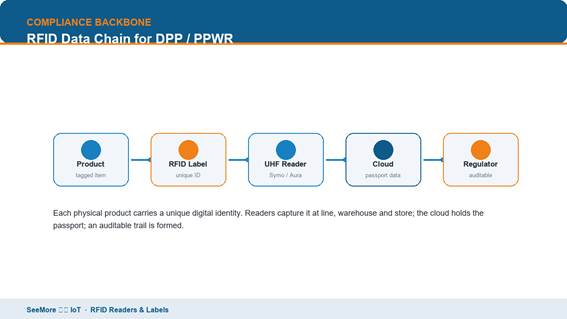
SeeMore 星眸 · EU DPP & PPWR: RFID Is the Data Backbone Behind Compliance
What DPP and PPWR actually are
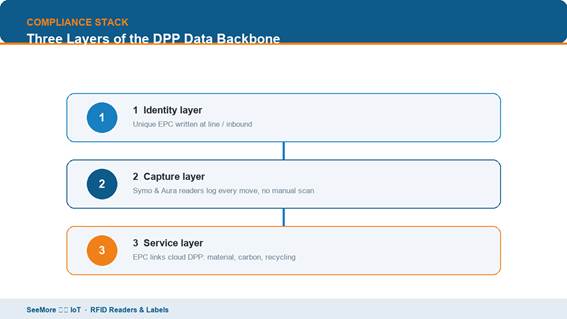
SeeMore 星眸 · 方案示意图 — EU DPP & PPWR: RFID Is the Data Backbone Behind Compliance
The EU's Digital Product Passport (DPP) requires regulated products to carry machine-readable identity and sustainability data that consumers, regulators and recyclers can all access by scan. The companion PPWR (Packaging and Packaging Waste Regulation) tightens rules on recyclability and recycled-content share of packaging, and expects packaging to be identifiable and countable too.
Together, the two rules turn a small question — "who am I, where did I come from, can I be recycled?" — into something every product must answer at the point of manufacture. It is no longer a page in a CSR report; it becomes hard data that enters purchase lists, customs files and platform audits.
What actually sits inside a DPP
A digital product passport is not an "ID photo" but a set of structured data that keeps expanding with the regulation. Typical fields include:
· Material composition and origin: main materials, hazardous substances, recycled-content share.
· Repair and disassembly guidance: repairable or not, how to take it apart, which parts are replaceable.
· Carbon footprint and energy: environmental load across production, transport and use.
· Supply-chain nodes: key traceable steps from raw material to finished good.
For these fields to be "scannable on demand", there must be a reliable physical entry point — and that is exactly what an RFID tag delivers: it pins that structured cloud data onto the physical product.
How PPWR connects to RFID
PPWR turns packaging recyclability, recycled content and reuse rate into hard metrics. RFID does two jobs here:
· Packaging-level ID: tag cartons, totes and pallets so whole batches are countable and sortable as they move; the packaging stats PPWR needs are captured naturally at the edge.
· Reusable-packaging tracking: once reusable plastic containers (RPCs) are tagged, every return, wash and re-issue is logged, directly backing PPWR's reuse-rate metric and letting a company prove "we cut plastic" with data.
Why legacy barcodes fall short
1D barcodes and QR codes can store information, but they have three gaps in a compliance setting:
· Must be aimed at: manual one-by-one scanning does not scale to tens of thousands of units on a line or in a warehouse, and misses/errors are common.
· No bulk or distance: you cannot read a pile of labels at speed as goods pass by.
· Weak link to the physical world: where the label is, whether it is still there, whether it was swapped — the code alone cannot tell you.
UHF RFID reads hundreds of tags per second from meters away, and every tag carries a globally unique number (EPC). That makes it the natural way to pin a "digital identity" onto a "physical product".
The role of RFID in DPP / PPWR
We treat RFID as the data backbone of compliance, in three layers:
1. Identity layer: at line or inbound, write a unique EPC to each item (or lot). The tag becomes the physical entry point to the product passport.
2. Capture layer: deploy SeeMore readers at line, warehouse and store — the Symo integrated/fixed series and the Aura desktop series — to record every movement automatically, with no manual steps.
3. Service layer: the EPC links to cloud DPP data (materials, carbon footprint, recycling guidance); anyone can scan to see it, and the packaging statistics PPWR needs are captured naturally at the edge.
Three common misconceptions
· Myth 1: DPP is only for giants. In reality big customers (retailers, brands) pull traceability data up the chain — if you do not tag, you may drop off their supplier list.
· Myth 2: act when it is forced. DPP requires machine-readable identity at manufacture; line retrofit, data integration and supply-chain coordination are measured in months, so the later you start the more likely you stall at the effective date.
· Myth 3: barcodes are enough. Barcodes' gaps in bulk, distance and physical binding make them inherently insufficient for compliance-grade tracing.
Practical advice for exporters
· Do not wait for the "effective date". DPP rolls out in phases; the earlier you lay the RFID identity layer, the cheaper any later platform integration becomes.
· Tag choice must respect materials: liquid, metal and carbon-black rubber all hurt read performance, so you need spec-matched labels (exactly why we push ARC-certified labels).
· Pick readers by scenario: fixed points use integrated/fixed units, bench counting uses the Aura A032 desktop, mobile counts use handhelds.
|
▶ Preparing product compliance for the EU market? Tell SeeMore your category, line takt and current traceability method. We deliver a one-stop DPP data-backbone — from tags to readers to cloud integration — and send samples first so you can test read performance. |

Tel : +8618682338756
Email : info@seemoretek.com
Whatsapp : +8618682338756


© 2026 SeeMore IoT Technlogy Co.,Ltd. All Rights Reserved.