
Search info
What Are You Looking For?
The real difficulty in medical consumables management has never been whether a system exists, but whether that system can keep pace with the speed at which consumables move. High-value consumables travel from the central warehouse to secondary storage, from the operating room to the patient, passing through multiple hands and multiple handovers—and every handover can create a data break. Manual stocktaking fills in paper ledgers one by one, but it cannot close the gap between records and reality. SeeMore IoT uses UHF RFID smart cabinets as its hardware anchor to push consumables management from “after-the-fact backfilling” toward “in-process awareness,” capturing every state change at the moment it occurs.

The first problem is the “static failure” of inventory. Industry statistics show that at some healthcare institutions, capital tied up by excess inventory reaches 15%–20%, and waste caused by expiration or damage exceeds 5%. The issue is not that inventory quantities are insufficiently precise; it is that inventory data is “after-the-fact.” When the system shows that a certain batch of consumables is sufficient, a clinical shortage may already have occurred. When the system indicates that a consumable still has remaining stock, it may already have been used without charge capture.
The second problem is the “time gap” in traceability. Traditional traceability for high-value consumables often relies on backfilling information after use. Once a quality issue or recall occurs, tracing becomes like searching for a needle in a haystack. If the binding of batch numbers and expiration dates to patient information for high-value consumables such as orthopedic implants and interventional catheters depends on manual entry, data breaks are almost unavoidable.
The third problem is the pressure of compliance. UDI has entered the phase of full implementation (2027), and DRG/DIP payment reform has also imposed clear requirements for real-time cost accounting of consumables. The limitations of traditional barcodes in batch reading and dynamic capture mean that, when facing regulatory requirements for “one item, one code, full-process traceability,” hospitals often can only compensate for the technical gap with manpower.
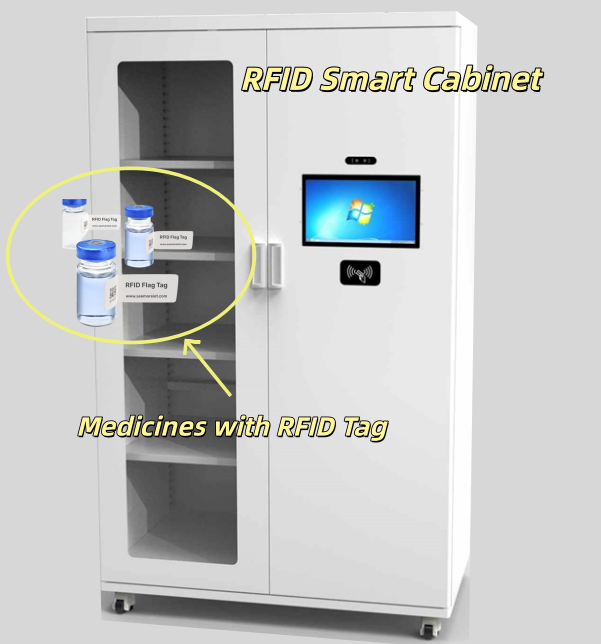
In medical scenarios, SeeMore IoT’s role is first and foremost that of a reliable UHF RFID hardware provider. The core performance of a smart cabinet depends on capabilities at three physical levels: reading certainty, shielding tightness, and depth of integration with hospital information systems.
At the reading level, SeeMore IoT’s UHF RFID modules and antenna designs are developed around the actual storage forms of medical consumables. Densely stacked consumable packaging inside cabinets, interference from metal instruments, and signal attenuation in liquid environments can all affect tag activation efficiency. SeeMore IoT’s near-field antenna solutions (such as the SA300N embedded antenna) are specifically optimized for short-range, precise reading scenarios such as medical tools. Combined with anti-metal tag solutions, the smart cabinet can maintain stable item-level reading capability even on metal instrument surfaces or under high-density storage conditions. Measured data from comparable industry solutions show that, with proper cabinet shielding and antenna layout, a full inventory count of cabinet-level consumables in the hundreds can be completed within seconds, with reading accuracy reaching 99.9% or higher.
Shielding capability is the fundamental difference between a smart cabinet and an ordinary shelf. “Cross-reading” when cabinet doors are not fully closed, and signal interference between adjacent cabinets, are hidden sources of inventory data distortion in medical scenarios. A qualified medical-grade smart cabinet must achieve effective electromagnetic isolation at the cabinet structure level, with door-gap cross-reading distance controlled to the centimeter level and shielding attenuation reaching dB-level indicators. SeeMore IoT’s fifteen years of engineering accumulation in the RFID hardware field enables it to calibrate antenna layout, power control, and cabinet structure as a whole, rather than simply “installing a reader into a metal cabinet.”
More critically, there is integration capability. If the data generated by a smart cabinet cannot enter the hospital’s HIS, SPD, or HRP systems, it is merely an isolated “electronic drawer.” SeeMore IoT’s fixed reader product line supports open SDK interfaces, allowing system integrators to write cabinet reading events, inventory changes, and operator identity information into the hospital’s existing information systems in real time, forming a complete data link from cabinet to backend.
Scenario 1: “Intraoperative-level” traceability of high-value consumables in the operating room. Traceability of orthopedic implants and interventional consumables must be precise down to “which item of consumable was used on which patient at what time.” The smart cabinet automatically associates the removal action of consumables with surgical scheduling and patient information, eliminating the need for post-operative backfilling. Data from a six-month application at a tertiary hospital show that 100% full-process traceability of high-value consumables was achieved, inventory accuracy rose from 70% to over 95%, inventory turnover increased by 50% annually, and costs were reduced by approximately 20%. The value of traceability goes beyond compliance—when a recall event occurs, the time required to locate the problematic batch is compressed from “hours” to “minutes,” directly reducing the clinical risk exposure.
Scenario 2: “Unmanned” inventory self-healing in secondary storage. Department-level secondary storage is the “capillary” of consumables management and also the scenario most easily occupied by the inefficiency of manual stocktaking. The batch reading capability of RFID readers improves stocktaking efficiency by an order of magnitude compared with manual work, and every retrieval and return automatically triggers an inventory update, no longer relying on the passive rhythm of “counting only when someone remembers to.” After RFID was applied in the central warehouse of a tertiary hospital, inventory accuracy increased from 82% to 99.6%, and stocktaking time was reduced by 75%. The smart cabinet extends this capability from the warehouse to the clinical frontline, giving secondary-storage inventory data “real-time usability” for the first time.
Scenario 3: Expiration management through “active alerts” rather than “passive checks.” UDI codes carry key information such as batch number, expiration date, and sterilization status of consumables, while RFID is responsible for refreshing this information in real time at every read. The smart cabinet can automatically trigger an alert when consumables approach expiration, rather than discovering during a monthly stocktake that a certain batch has already expired. Expiration management shifts from “people finding problems” to “the system pushing problems,” and the risk of expired consumables entering clinical use is intercepted upstream in the process.
Scenario 4: Data from the same source for UDI compliance and DRG cost accounting. Full implementation of UDI requires consumables to leave standardized identification records at every circulation node. Each read by the smart cabinet naturally generates a UDI-associated data record with a timestamp, meeting compliance data generation requirements without additional manual entry. At the same time, this real-time consumption data directly supports disease-based cost accounting under DRG/DIP—consumable costs no longer rely on post-hoc allocation but are aggregated at the moment of use.
The input-output of smart cabinets is not a single-dimensional matter of “how much stocktaking labor is saved.” The real ROI comes from the narrowing of three structural losses. Capital tied up by excess inventory is compressed downward from the industry high of 15%–20%; even releasing only a few percentage points corresponds to considerable working capital. Expiration and damage waste is continuously squeezed by expiration alert mechanisms from a level above 5%. Consumable leakage rates decline significantly under the closed loop of “retrieval equals charge capture”; pilot data from a provincial hospital show a 90% reduction in leakage rate and a 40% improvement in requisition process efficiency. Combined with a substantial reduction in stocktaking labor and fewer surgical delays, the investment payback period for most healthcare institutions falls in the range of about one year. The economic evaluation of the high-value consumables RFID project at Hospital Clínic de Barcelona likewise reached a favorable ROI conclusion supporting system scalability.
The requirements of medical scenarios for RFID hardware are fundamentally different from those of retail or warehousing. The metal content of consumables, signal attenuation in liquids, high-frequency door openings and retrievals, tag erosion in disinfection environments, and the stability requirements of 7×24 uninterrupted operation all widen the distance between “can read” and “reads accurately.” SeeMore IoT’s value does not lie in providing a smart cabinet with a “feature list,” but in distilling UHF RFID RF engineering capability into certainty for medical scenarios: how antennas should be laid out to avoid missing reads in dense storage, how shielding should be designed to prevent cross-reading between adjacent cabinets, and how tags should be selected to maintain consistent activation efficiency on metal instruments and liquid packaging. The answers to these questions are not in the software interface; they lie in the precision with which hardware and scenario fit together.
When the smart cabinet no longer requires clinical staff to “cooperate with management,” but instead makes every movement of consumables automatically part of the data, medical consumables management has truly completed the switch from manpower-driven to system-driven. SeeMore IoT’s UHF RFID smart cabinet is a reliable hardware foundation at exactly this switching point.

Tel : +8618682338756
Email : info@seemoretek.com
Whatsapp : +8618682338756


© 2026 SeeMore IoT Technlogy Co.,Ltd. All Rights Reserved.