
Search info
What Are You Looking For?
Asset stocktaking is a routine every organization performs and few perform well. The mismatch is structural: barcodes require a person to find each label, orient a scanner, and capture one read at a time. When thousands of assets are spread across floors, cabinets, and locked rooms, counting becomes an exercise in reachability rather than accuracy. The count takes days, is stale before it is finished, and the variance between records and reality is treated as unavoidable.
UHF RFID changes the unit of work from “one asset at a time” to “one zone at a time.” A passive UHF tag can be read without line of sight, at range, and in batches. A handheld reader moving through an aisle captures hundreds of tags per second, turning stocktaking into a continuous sweep rather than a sequence of individual decisions.
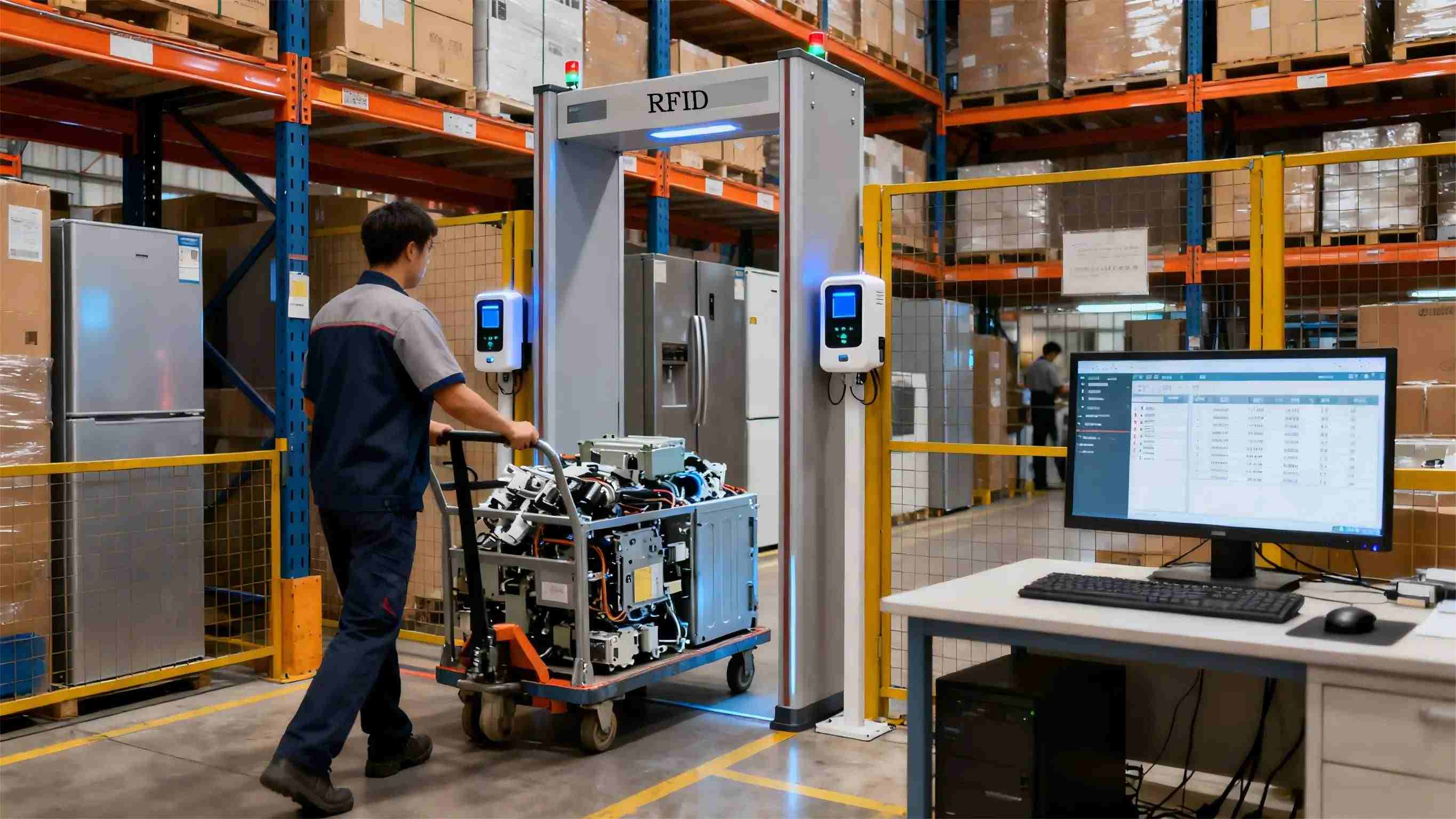
Why Barcode Counting Breaks Down
Barcode accuracy is high in controlled conditions. Real asset environments are not controlled. Assets sit on high shelves, inside cabinets, behind other assets, on metal carts, and in rooms that are locked when the counting team arrives. A label that cannot be seen cannot be scanned. The easy assets get counted, the difficult ones get estimated, and the variance concentrates in exactly the categories that matter most—IT equipment, instruments, tools, and metal fixtures.
The cost is not just labor. Assets recorded but not found inflate book values; assets present but unrecorded create compliance exposure; and recurring true-up adjustments erode confidence in the asset register itself.
The UHF RFID Logic
Passive UHF RFID in the 860–960 MHz band works by having a reader emit an RF field; a tag in that field harvests energy and backscatters a unique identifier. Because the tag needs no battery and no line of sight, the reader captures every tag in its field in rapid succession. Current handhelds support read rates from hundreds to over a thousand tags per second, with read ranges from a few meters to the low tens of meters depending on tag type and power.
The operator’s job shifts from “find and scan” to “cover the zone and verify exceptions.” In fixed-asset deployments using on-metal tags plus handheld terminals, cross-floor annual stocktakes have been compressed to tens of minutes, with recognition rates above 90% at 2–6 meters.
The hardware question then becomes: what does the tag need to survive, and what does the reader need to deliver, for this logic to hold across a real asset base?
The Label Tag: Default for Assets That Can Carry a Thin Label

The standard UHF RFID label tag is the workhorse of asset stocktaking. It is a thin, flexible inlay—PET or paper substrate with an etched aluminum antenna and a RAIN RFID chip—supplied on rolls and printable with human-readable IDs and barcodes in the same pass. It is inexpensive enough to apply at the asset level and readable at meters of range rather than centimeters.
For non-metallic or low-metal surfaces—plastic equipment housings, furniture, archive boxes, IT peripherals, shelving units, and general fixtures—the label tag is the correct default. On non-conductive surfaces, UHF tags achieve their best performance: read distances in the range of 12 meters in open environments have been measured on plastic and polymer surfaces, with stable performance across curved housings.
The label tag’s limitation is a boundary condition, not a defect. A standard label placed directly on metal detunes. The metal pulls the antenna’s resonant frequency away from the UHF band and reflects energy back into the chip, collapsing read range from meters to centimeters. That boundary is where the second product becomes necessary.
The On-Metal Tag: Making Metal Part of the Design
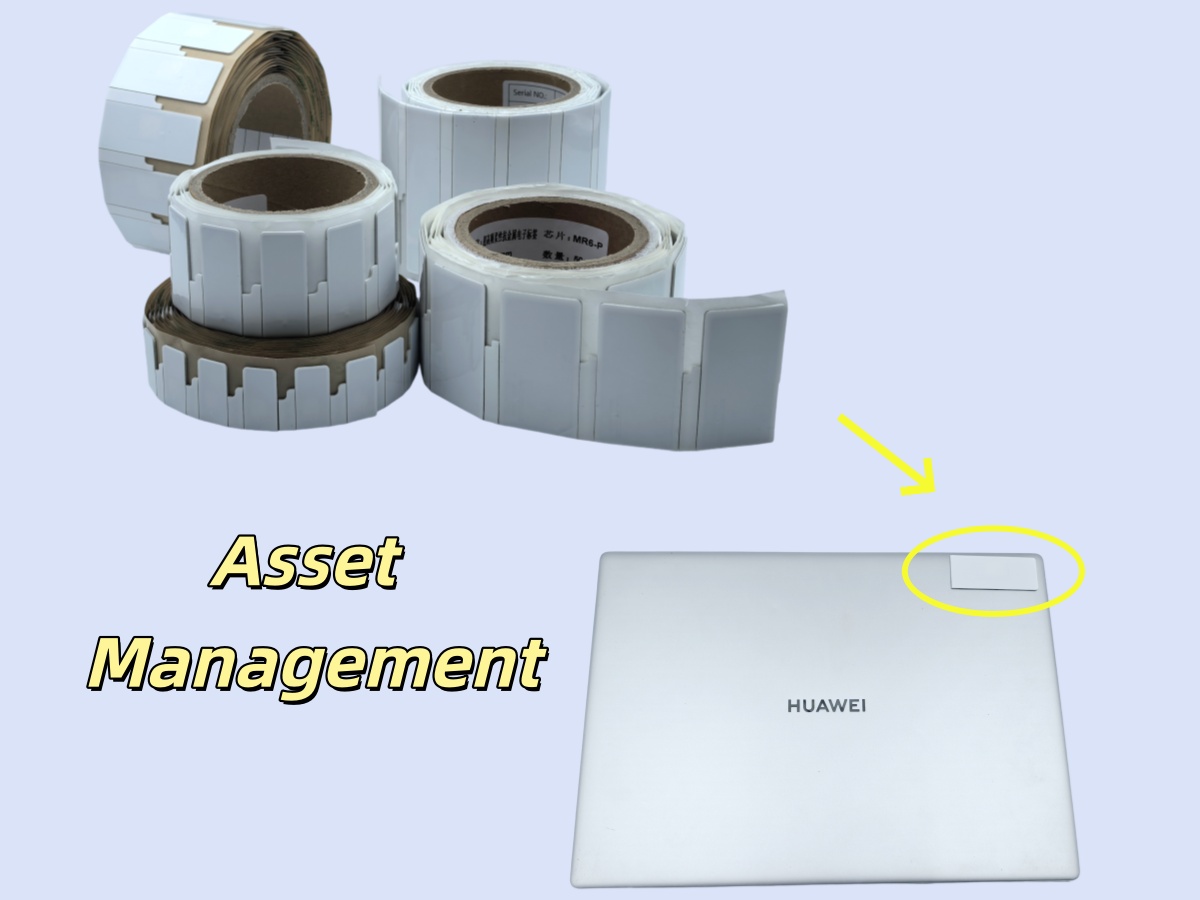
Metal is not an edge case in asset stocktaking. It is the dominant material in many of the asset categories that matter most: server chassis, steel cabinets, machine tools, medical instruments, carts, racks, and industrial fixtures. The on-metal tag exists because the problem is the physics of the interface, not the tag’s sensitivity. The solution is to insert a spacer or ground plane between the antenna and the metal surface, so the metal becomes part of the antenna’s design environment rather than a source of detuning.
On-metal tags come in flexible and rigid families. Flexible on-metal tags—SeeMore’s FL7030, for example, at 70×30×1.25 mm—use a PET substrate and an etched aluminum antenna with a spacer layer, delivering 8 meters of handheld read range and 12 meters with a fixed reader on metal surfaces. They conform to flat and gently curved metal faces: server front panels, laptop lids, monitor backs, metal shelving. Because they are thin and printable, they can carry both the EPC and a human-readable asset ID in a single pass.
Rigid on-metal tags trade conformability for survivability. An ABS or PC shell with through-holes for screws or rivets, rated IP65 and above, is the correct choice for assets that live outdoors, get washed down, or are handled roughly. Compact rigid formats and micro PCB tags exist for tools, instruments, and tight spaces.
Measured on-metal read ranges in the 4–9 meter band are typical for passive tags on metal. The stocktaking use case does not require record-setting distance; it requires stable, repeatable reads at handheld range across the asset population, without the operator having to hunt for a tag.
The Handheld Reader: Where the Stocktake Actually Happens
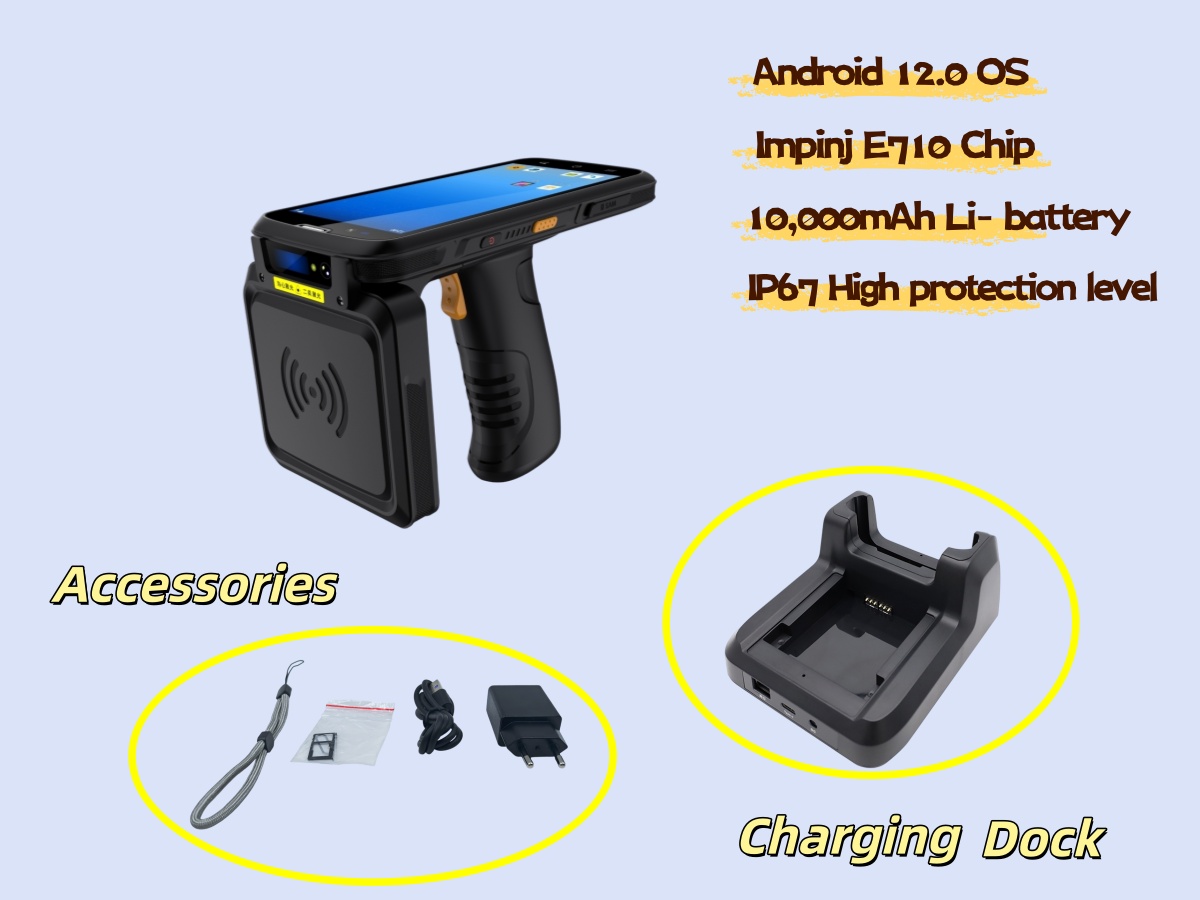
The tag determines what can be read. The handheld reader determines whether the stocktake is operationally tolerable. Three parameters matter in practice: read rate, read range, and ergonomics.
Read rate sets the pace of the sweep. Devices range from roughly 200 tags per second in compact pistol-grip formats to over 1,300 tags per second in high-performance units. For asset stocktaking, the practical difference is whether a dense cabinet or crowded rack clears in one pass or requires repeated passes. A reader that sustains 700–900 tags per second with stable anti-collision performance handles most fixed-asset densities without the operator needing to slow down.
Read range determines how much physical coverage one pass can achieve. A handheld with 12–13 meters of nominal range on free-space labels allows the operator to capture assets on high shelves and across a room without repositioning for every read. On-metal tags read shorter, which is a function of the tag, not the reader; a capable handheld preserves enough margin that the on-metal population remains readable at practical working distances.
Ergonomics is the parameter specification sheets underweight and operators do not. A stocktake is a sustained physical task. A device that weighs over 600 grams with a poorly balanced grip produces wrist fatigue before the count is finished, and fatigue produces missed zones. Battery capacity and thermal behavior matter for the same reason: a device that throttles or dies mid-sweep reintroduces the discontinuity RFID was meant to eliminate.
What the Combination Delivers
The business case is not primarily about labor savings. The largest return comes from eliminating the variance that barcode counting leaves behind.
In one fixed-asset deployment, RFID reduced inventory time from 30 days to 4 days and raised accuracy from below 85% to 99.3%. Unlocated assets fell from over 800 to fewer than 20, and accounting discrepancies were eliminated. In an industrial distributor case, UHF readers cut person-days by 90%, lifted accuracy to 99.1%, and delivered 374% ROI over five years; inventory shifted from a quarterly event that partially halted operations to a continuous activity embedded in normal work.
These results share a common structure. RFID does not merely count faster. It removes the conditions that make counting inaccurate: the unreachable asset, the hidden label, the manual transcription, and the reconciliation adjustment after the fact. When the count is complete and current, the asset register becomes a decision input rather than a historical artifact.
The market reflects this logic. The global UHF RFID asset management tag market was valued at roughly US955~983millionin 2024, with forecast above US 2billion by the early 2030s. Passive UHF tag pricing has compressed to US$ 0.05–0.50 per unit at scale, shifting the cost calculus from “can we afford to tag every asset” to “can we afford not to.”
SeeMore IoT’s Position
SeeMore IoT’s contribution to this application is the hardware layer that makes zone-level stocktaking physically reliable across a heterogeneous asset base. The label tag covers assets that can carry a thin inlay. The on-metal tag family—flexible where conformability matters, rigid where survivability matters, compact where space is constrained—covers the metal assets that standard labels cannot reach. The handheld reader provides the read rate, range, and ergonomic endurance to complete a sweep in a single session.
The engineering constraint that ties these three products together is the same one that determines whether a stocktake succeeds in the field: the tag must match the surface, the reader must sustain the rate, and the combination must be operable by a person walking through a real space. SeeMore IoT’s fifteen years of RF engineering sit in that constraint—in the antenna design of the on-metal tags, in the sensitivity and anti-collision performance of the reader, and in the calibration that keeps a flexible on-metal tag readable at 8 meters on a server chassis rather than detuning into silence.
When the hardware holds that constraint, stocktaking stops being an event that interrupts operations and becomes a capability that runs alongside them.

Tel : +8618682338756
Email : info@seemoretek.com
Whatsapp : +8618682338756


© 2026 SeeMore IoT Technlogy Co.,Ltd. All Rights Reserved.